Wednesday, February 24, 2010
It's the TEACHERS, stupid.....(maybe I shouldn't say that)
The success of a New York City Charter school, prompted New York Times columnist Bob Herbert to investigate. It's the teachers that make a difference, not the materials, not the textbooks, not the state standards, technology or the proficiency tests. The differences that make a difference in the lives of students are most always tied to an exemplary teacher. Have you hugged a teacher today? I did (it was pretty easy since Jan was by my side at the time). How about you? Read Herbert's article. This captures what we seek to do at The Graham Family of Schools.


Tuesday, February 23, 2010
The visual augmented reality world of our student's future
I made an early comment about how incredible this new application (Bing) in connecting geographic map, in both real and historical time. A map to the world and to the skies from any place, anytime. I am seldom stunned by new stuff because it doesn't seem to matter all that much to me. But this application of augmented reality that the folks at Microsoft have demonstrated and released challenges most aesthetics. It extends what a person can "see" and construct by augmenting both space and time. This application finally let me see what video game designers and players have always seen, but when integrated into maps with pictures and live images of real places that change as the day changes.....pretty cool. I think this might help us all think about where our students are located in the world.
Bing Maps
Bing Maps
Classroom of the Future Reflections
We had a follow up meeting with folks from eTech Ohio yesterday. They are really solid folks with great instincts about technology and learning and how to demonstrate it at a big state conference. We'll be talking with lots of folks about these efforts for future conferences. The good news is that the classroom walls designed and built by students at the Easton Career Center was saved and will be a great starting point for next year.
Several more presenters from the COF reflected on their experiences at the conference. The important general take away that almost everyone had was -- we can do this. We have to do this. But we need to address issues of policy in order to truly integrate technology into teaching and learning.
TheCellt
Several more presenters from the COF reflected on their experiences at the conference. The important general take away that almost everyone had was -- we can do this. We have to do this. But we need to address issues of policy in order to truly integrate technology into teaching and learning.
TheCellt
Thursday, February 18, 2010
Classroom of the Future teachers reflect on their experience
At eTech Ohio this year The Center for Experiential Learning Leadership and Technology (CELLT) helped to coordinate activities. Teachers from The Graham School and The Charles School at Ohio Dominican University choose lessons that they had used successfully in their classrooms. We asked them to incorporate new processes and technologies into these lessons. Mobile Computing and Open Educational Resources were selected to explore in depth because they are quite likely to impact teaching and learning in classrooms sooner rather than later.
You can see both examples of them presenting in a classroom of the future as well as these talented teachers think and reflect on their work at our YouTube site: http://www.youtube.com/user/TheCELLT
Your thoughts?
You can see both examples of them presenting in a classroom of the future as well as these talented teachers think and reflect on their work at our YouTube site: http://www.youtube.com/user/TheCELLT
Your thoughts?
Wednesday, February 17, 2010
Lecture time in the digital age
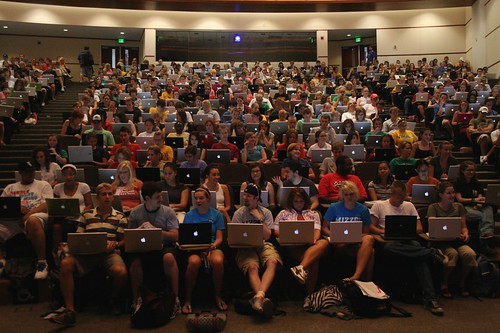
Here's a great shot of students from the University of Missouri School of Journalism taking a "class" in a contemporary lecture hall. So how are we doing preparing our K-12 students for this reality? Or maybe this isn't the future, just a transition to something else. Wonder what that might be?
Sunday, February 14, 2010
New Amazing Stuff from Bing -- Microsoft Maps
The folks at Microsoft deserve a big.....wow on this one. Their new integration of applications through mapping is really incredible. Be sure you watch the TED presentation all the way to the end for some incredible wow.
Wednesday, February 10, 2010
Policy Issues largest challenges for integrating technology into classrooms
There are these three interdependent aspects of technology -- devices, markets, policy. We have wonderful devices that do all sorts of things that could make teaching and learning better, more exciting, closer to the devices that children already have. There are markets for these devices -- teachers, students, schools that would like to buy these devices to help with teaching and learning; there are likewise tons of sellers of products and services. There are policies that govern and "control" how these devices can be used and for what purpose. By and large, we were reminded by teachers and administrators at eTech Ohio that district wide and school level policies ban devices from the school grounds. Sometimes cell phones and iPods are allowable in schools before classes, but must be in lockers after school starts. Some places ban phones and iPods from lockers too. Most everywhere the most powerful and student-friendly devices -- portable computing (cell phones, lap tops, iPhones) and iPods are confiscated if seen or heard.
These policies are well intentioned and in service of trying to protect students from unwanted content and constant distraction. Sites are blocked in schools because there is inappropriate content lurking next to excellent content (YouTube, iTunes. Some of the most widely used sites on the internet like Wikipedia are banned from schools because they are open content controlled rather than editorial board controlled. These policies are well intentioned but they miss what is happening in the world around us and our students. These devices will only be replaced with yet more dazzling goo. What I'm hoping for is that educators will rise up and propose and use new policies that are appropriate for this new era of learning.
The policy on cell phones that I really like is: Have students place their cell phones on their desks in full view of everyone. Try and incorporate the cell phone into as many lessons as possible. Have the class discuss and write a policy for the appropriate use for cellphones in your class. Have the class collaboratively write a policy for appropriate use and the consequences for inappropriate use. Have students help in "in-forcing" the rules. A classroom up approach is needed in my view.
Your comments and suggestions?
These policies are well intentioned and in service of trying to protect students from unwanted content and constant distraction. Sites are blocked in schools because there is inappropriate content lurking next to excellent content (YouTube, iTunes. Some of the most widely used sites on the internet like Wikipedia are banned from schools because they are open content controlled rather than editorial board controlled. These policies are well intentioned but they miss what is happening in the world around us and our students. These devices will only be replaced with yet more dazzling goo. What I'm hoping for is that educators will rise up and propose and use new policies that are appropriate for this new era of learning.
The policy on cell phones that I really like is: Have students place their cell phones on their desks in full view of everyone. Try and incorporate the cell phone into as many lessons as possible. Have the class discuss and write a policy for the appropriate use for cellphones in your class. Have the class collaboratively write a policy for appropriate use and the consequences for inappropriate use. Have students help in "in-forcing" the rules. A classroom up approach is needed in my view.
Your comments and suggestions?
Subscribe to:
Posts (Atom)

